Fallen Phrase Puzzle
A free fallen phrase puzzle maker: paste a phrase, choose how many columns it falls into, and print a page where every column has dropped by its own amount. The answer page prints the phrase as it should read. No login, no cap, and an optional seed that rebuilds the same fall later.
Nothing to print yet. Go back to the page, type a phrase, and press Make fallen phrase. Print again and you will get the puzzle page, followed by the answer page.
Your fallen phrase
Both pages are drawn at print resolution, so the letters stay solid on paper.
What a fallen phrase puzzle is, and what this maker does
A fallen phrase puzzle takes one phrase and turns it into a column of letters that have all slipped downwards. The phrase is laid into a few columns, and then every column drops by a different amount — the letters keep their order, but the starting point moves. The solver's job is to slide each column back up until the phrase reads across.
That is exactly what this page does. Paste a phrase, pick how many columns it should fall into, and two pages come out:
- The puzzle page carries the fallen columns and nothing else. No hint letters, no arrows, no instructions competing with the puzzle.
- The answer page carries the phrase as it should read, printed in one line along the bottom of the sheet.
The fall is a rotation, and it is never zero
The phrase is split into equal-length columns and each column is rotated: the letters that would fall off the bottom reappear at the top. Nothing is scrambled and nothing is thrown away, which is what makes the puzzle solvable — the sequence inside a column is intact, only its starting point has moved.
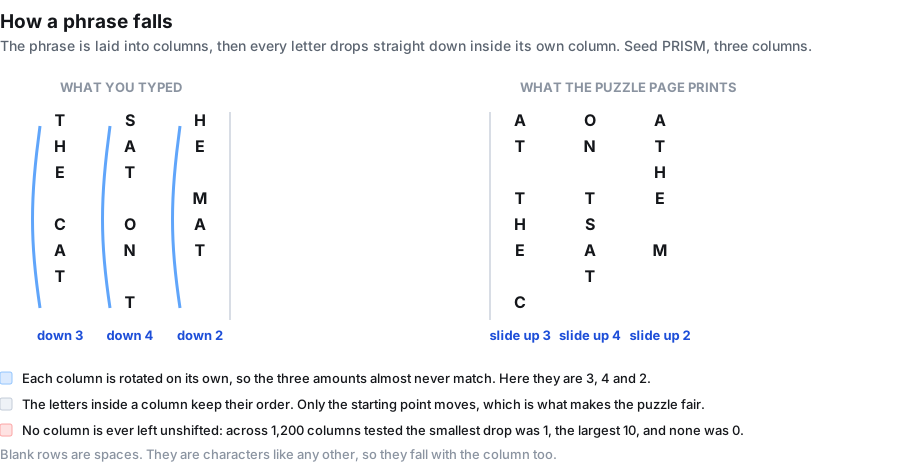
Here is the default phrase falling into three columns, seed PRISM, straight from this tool:
| Column | As you typed it | As the puzzle page prints it | Dropped by |
|---|---|---|---|
| 1 | THE CAT | AT THE C | 3 |
| 2 | SAT ON T | ON TSAT | 4 |
| 3 | HE MAT | ATHE M | 2 |
Two things are worth noticing, and neither is obvious from looking at a printed puzzle. First, each column drops by its own amount, so you cannot work one column out and copy it to the others. Second, no column is ever left unshifted. The drop is chosen between 1 and one less than the column length, so a column can never come out already solved. We checked that on 1,200 columns rather than trusting the arithmetic: the smallest drop found was 1, the largest 10, and none was 0.
The gaps are not word gaps
Spaces are characters like any other here. A space takes up a row in its column, counts towards the 120-character limit, and falls with the column like a letter does. So after the fall, a blank row no longer marks where a word ended.
That is the opposite of what happens in a letter-for-letter cipher, where word lengths survive and a solver can lean on them. Here the gaps are noise: they move to wherever the rotation puts them, so the solver cannot read word boundaries off the sheet and has to work from the letters alone. If you want the version that does leave word lengths and punctuation as clues, the cryptogram maker is the one that keeps them — it enciphers a sentence letter by letter and prints the whole key on its answer page.
Columns are the whole difficulty decision
There is one real control, and it is the column count. More columns means fewer letters per column, which means less to slide — and because each column is independent, fewer columns also means each one is worth more once it is right.
| Columns | Letters in each column, for the 43-character default phrase | What it feels like |
|---|---|---|
| 1 | 43 | One tall stack. Only one thing to slide, but it is the whole phrase. |
| 2 | 22 | Two stacks. The drop amounts are unrelated. |
| 3 | 15 | A comfortable classroom sheet. |
| 4 (the default) | 11 | Short columns, and the safest choice for a long phrase. |
The split is by even chunks, not by words: the tool divides the phrase into equal lengths with ceil(length ÷ columns) characters each, so a column can end in the middle of a word and the last column is often shorter. For the 43-character default phrase that gives columns of 11, 11, 11 and 10 characters.
How long a phrase still fits on the sheet
Columns decide whether the letters stay on the paper as well as how hard the puzzle is. The sheet is one page, 1600 by 2072 pixels, and the letters start 60 px below the text area and run down in fixed steps: 40 px apart at font 18 or below, 48 px at font 26, 52 px at font 30. Working from that geometry, this is what fits above the footer:
| Columns | Phrase length that fits at font 16 | Phrase length that fits at font 26 |
|---|---|---|
| 1 | 41 characters | 35 characters |
| 2 | 82 characters | 70 characters |
| 3 | 123 characters | 105 characters |
| 4 | 164 characters | 140 characters |
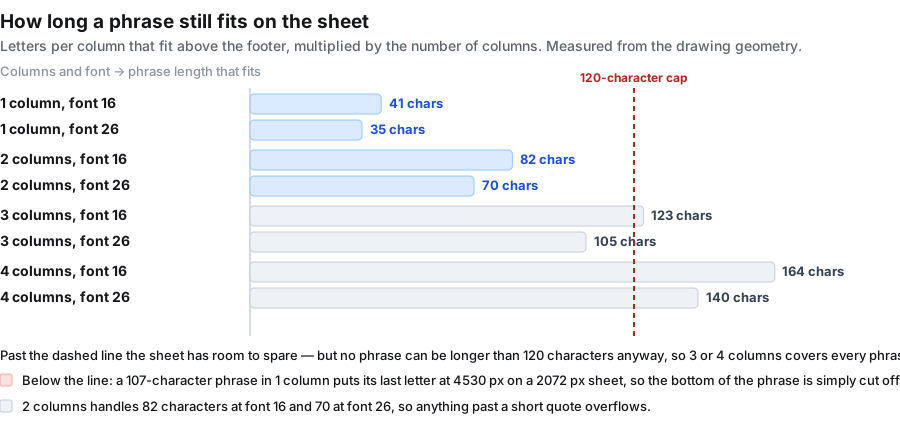
Where this actually bites. The tool does not warn you and does not shrink the letters, so a phrase that is too long for its column simply runs off the bottom of the page. Measured: a 107-character phrase in one column puts its lowest letter at 4530 px on a 2072 px sheet, and even the 43-character default phrase reaches 1970 px in a single column — past the text area, which ends at 1922 px, and into the footer. In two columns the same 107-character phrase still reaches 2410 px.
The safe rule: three or four columns for anything longer than a short line. At four columns a 107-character phrase ends at 1538 px at font 26, comfortably inside the page.
The 120-character limit, and it is silent
A phrase is cut at 120 characters, after runs of spaces are collapsed into one. There is no counter on the page and no warning: we fed the tool 119, 120, 121 and 240 characters and it printed 119, 120, 120 and 120. Anything past the cut is simply not there. If your quote is longer, shorten it or split it across two puzzles.
Two related details from the same tests. Very short phrases leave blank columns — with four columns, a two-letter phrase fills two of them and the other two print nothing, because the split is by equal chunks rather than by words. And digits, punctuation and accented letters are kept as typed; only the phrase is set in capitals.
The seed: rebuild the same fall later
Left blank, every press drops the columns by fresh amounts. Filled in, the fall is pinned: the same seed with the same phrase and the same column count produces the same puzzle every time.
Same seed plus same phrase plus same column count gives the same fall. Something like yr5-week2 is enough.
Three honest limits, all checked rather than assumed:
- All three parts are in the recipe. Change the phrase, the seed or the column count and you get a different fall. The column count matters because it changes how the phrase is split.
- The answer page does not change at all. It prints your phrase, so it looks the same whatever the seed is. That is the opposite of the maze generator, where pinning the seed pins the answer route as well.
- A blank seed is genuinely random. Press twice with the box empty and you get two different falls. If you liked one and did not write the seed down, it is gone — there is no history to scroll back through.
How to solve a fallen phrase puzzle
The method is mechanical once you see it, and it needs no key:
- Pick the column with the fewest letters. Fewer letters means fewer possible offsets to try.
- Slide it up and read downwards. Because the order never changes, the column is either right or obviously wrong — you are looking for letter pairs that look like the start of words.
- Use what you already have. Once two columns are placed, the letters next to them constrain the third, because the phrase has to read across.
- Expect gaps that mean nothing. A blank row is not a word break; it moved with the column. Read the letters and let the phrase decide where the words are.
- When it is solved, the whole phrase reads left to right across the columns. There is no diagonal and no reversed row.
If somebody gets properly stuck, the answer page is the way out: switch to the Answer page tab, or print it and keep it while they work.
What this fallen phrase maker does not do
Being clear about the edges saves you hunting for a control that is not there. Compared with the fallen phrase tools that rank around it, this page deliberately leaves out:
- No hint letters. Some makers let you give away a few letters up front, or reveal one when the solver is stuck. There is no such control here; the phrase is the only difficulty dial.
- No playing it on screen. There is no drag, tap or type version, no timer, no scoring, and no "finished words lock green" feedback. This is a print-and-write tool.
- No column widths to set. Only the number of columns is adjustable; they are always equal width across the sheet.
- No phrase library. You bring the phrase. There is no random-quote button and nothing here decides the content of your puzzle for you.
- No share link and no saved library. Nothing is stored, so there is no URL to send somebody. Print the page, or download the PNG or PDF and send the file.
- No batch mode. One puzzle per press. For a class set, press the button once per sheet — with the seed box left blank each one will be different.
- No commercial licence document. There is no account, no paywall and no watermark on the output, but the site does not issue a written licence either. If you need a signed commercial-use document for a puzzle book, this is not the place to get one.
Looking for the answer to a fallen phrase puzzle?
Then this page is the wrong half of the subject, and it is worth saying so plainly. Search suggestions for this puzzle include fallen phrase puzzle answers, fallen phrase puzzle solution, fallen phrase solver and fallen phrase puzzle solver online free, and a good part of that traffic is people wanting the answer to a puzzle that already exists — including one that appears as a daily on a well-known virtual pet site. This page is the maker: it builds a new puzzle from a phrase you supply. It does not solve somebody else's puzzle, it has no answer database, and it cannot look anything up.
The other half of that traffic is buying rather than making: the same search results include ready-made puzzle books on the big marketplaces. Those are for people who want puzzles to solve rather than a tool to build them, and again, not what this page is.
What this page is good for is the other direction: you have a phrase that matters — a class motto, a line from the book you are teaching, a birthday message — and you want it as a printable puzzle with an answer sheet, today.
Nothing you type leaves the browser
There is no upload step because there is no upload. The whole maker is script running in this tab: no request is sent, nothing is written to storage, and there is no account for anything to be attached to. Close the tab and the phrase you typed is gone.
Two consequences worth knowing. Once the page has loaded you can drop off the network and keep making puzzles, which helps on a locked-down school network or a patchy connection. And a phrase you would rather not put on somebody else's machine — a surprise, an inside joke, a message for one person — never sits on one.
Printing and exporting
Everything is black text on white, with no background fill to eat toner. Three ways out:
- PNG downloads the sheet at full pixel size, 1600 by 2072, which is handy for dropping the puzzle into a worksheet document or a slide.
- PDF writes a US Letter page, 612 by 792 points, with the sheet fitted inside half-inch margins.
- Print sends the page you are looking at to your printer. Switch to the Answer page tab first if you want the solved phrase on paper as well.
One measured caveat about the answer page: it prints the phrase in one line at 26 px bold across a text column 1420 px wide. Up to about 90 characters that line stays inside the column; at 92 characters it measures 1437 px and runs past the text margin, and a 107-character phrase measures 1641 px and runs off the 1600 px sheet altogether. Keep the phrase under roughly 90 characters if you want the answer line to sit cleanly on the page.
The other puzzles built into the same generator
The same page can build eleven puzzle types; this page simply has the fallen phrase selected. These are all of them:
Closest to this one is the cryptogram maker, which also starts from a sentence you supply but enciphers it letter by letter instead of dropping it. The word scramble generator mixes letters inside each word and prints a line to write the answer on. The word search generator hides words in a letter grid, and the criss-cross puzzle maker crosses whole words in a grid with no clues attached. The word puzzle maker page gathers the word-list types in one place, and the word puzzle generator page covers getting the identical sheet back later from a seed.
Frequently asked questions
What is a fallen phrase puzzle?
A phrase written into columns where every column has slipped down by a different amount. The letters keep their order, so the solver slides each column back up until the phrase reads across. This page makes one from a phrase you supply and prints it with a matching answer page.
How do you solve a fallen phrase puzzle?
Start with the shortest column, because it has the fewest positions to try. Slide it up one row at a time and read downwards; the letters are still in order, so the right offset is the one where word shapes appear. Then let the columns you have already placed constrain the rest, because the phrase has to read across all of them.
Is this fallen phrase maker free?
Yes, and there is nothing to unlock. No account, no credits, no monthly limit on how many puzzles you make, and no watermark on the printed page.
Do I have to sign up?
No. There is no login anywhere on this page. Open it, type a phrase, press the button. Nothing is saved for you, because nothing is saved anywhere.
How many columns should I use?
Four for anything longer than a short line, because that is what keeps the letters on the page. Three is a good classroom setting for a sentence of 30 to 100 characters. One or two columns are for short phrases only — with one column, even the 43-character default phrase runs down to 1970 px, past the point where the footer sits.
How long can my phrase be?
120 characters, counted after runs of spaces are collapsed. Anything past that is dropped without a warning: 121 characters and 240 characters both printed exactly 120. For the letters to stay on the page you also need enough columns — see the table above.
Why did the end of my phrase disappear?
Either you passed 120 characters, which the tool trims silently, or your columns are too long for the sheet. In one column a 107-character phrase puts its last letter at 4530 px on a 2072 px page, so most of it is simply off the paper. Raise the column count and lower the font size.
Why is one of my columns blank?
Because the phrase is short and the split is by equal chunks rather than by words. With four columns, a two-letter phrase fills two columns and leaves two empty. Use fewer columns for a very short phrase.
Are spaces counted as characters?
Yes. A space takes a row in its column and counts towards the 120-character limit, and it falls with the column like any other character. That is why the gaps in a fallen phrase do not line up with the ends of words.
Can I use numbers, punctuation and accented letters?
Yes. They are printed as you typed them; only the letters are set in capitals. Nothing is stripped out, and nothing is substituted.
Can I get the same puzzle again later?
Yes. Fill in the seed box and write the seed down. The same seed with the same phrase and the same column count rebuilds the same fall. Change any of those three and you get a different puzzle.
Does the seed change the answer page?
No. The answer page prints your own phrase, so it looks identical whatever the seed is. Only the puzzle page changes.
What happens if I leave the seed blank?
Every press drops the columns by fresh amounts, so no two puzzles come out the same. That is what most people want, and it also means a fall you liked is not recoverable unless you wrote the seed down.
Is any column ever left already solved?
No. The drop is chosen between 1 and one less than the column length, so every column actually moves. Across 1,200 columns tested the smallest drop was 1, the largest 10, and none was 0.
Can I give away a few letters to make it easier?
No. There is no hint control and no way to reveal a starting letter. The only difficulty dial is the column count, plus the length and word choice of the phrase itself.
Can I solve it on screen?
No. This is a print-and-write tool. There is no drag-and-drop version, no typing into blanks, no timer and no score. Print the puzzle page or download it and slide the columns with a pencil.
Does it need wifi to work?
It needs a connection to load the page the first time. After that it runs entirely in the tab, so you can go offline and keep making puzzles. Nothing is uploaded at any point.
Can I make several puzzles at once?
No. One puzzle per press, one page per puzzle. For a set of thirty, press the button thirty times and print each sheet — with the seed box left blank every one will be different.
Does it work on a phone?
Yes. The controls stack into one column on a narrow screen and the sheet scales to fit. Use the browser's share or print menu for output.
Where can I find the answer to a fallen phrase puzzle I already have?
Not here, and it is worth being straight about that. This page builds a puzzle from your phrase; it does not solve an existing one and has no answer database. If you have a printed puzzle in front of you, the method in the section above is the way through it.
Is a fallen phrase the same as a word scramble?
No. A scramble mixes the letters inside each word, so the word is still one unit on one line. A fallen phrase keeps every word intact and moves whole columns of a single phrase, so the letters to unscramble are the offsets rather than the letters themselves.
Is it the same as a cryptogram?
No. A cryptogram replaces each letter of the alphabet with another letter and leaves the layout alone, which is why word lengths survive as clues. A fallen phrase leaves every letter as itself and moves the columns instead. They are different puzzles that both happen to start from a sentence.
Is a fallen phrase the same as a drop quote?
Yes — that is the same puzzle under a different name. Drop quote, also written as one word, dropquote, is the name several puzzle publishers use for it, and it has its own article on Wikipedia; fallen phrase is another name for the same thing. Both work the same way: the letters of a saying are set into a grid, every column drops by its own number of rows, and the solver slides the columns back until the line reads across. The maker on this page builds that puzzle from a phrase you supply.