Printable Puzzles
Eleven puzzle types, each one printed as a puzzle page plus its answer page. Type your own words or type nothing at all. No account, no email, no watermark, and no cap on how many you print.
Nothing to print yet. Go back to the page, choose a puzzle type, press Generate puzzle, and print again. You will get the puzzle page followed by its answer page.
Your puzzle
Both pages are drawn at print resolution, so lines stay solid on paper.
Two pages out, every time
Whichever of the eleven types you pick, the result is the same shape of thing: one sheet holds the puzzle, a second sheet holds the answer to it. Both are drawn from a single layout in the same pass, so the answer page cannot disagree with the sheet you handed out. Because they are the same size, they line up if you print them back to back.
Neither page carries a watermark, and nothing in a corner asks a solver to sign up. Print six copies or six hundred; nothing here counts them.
Eleven types, and what each one needs from you
The thing that actually decides which puzzles you can make is not the type, it is what you have to hand. Five types want a list of words, three want one line of text, and three want nothing typed at all.
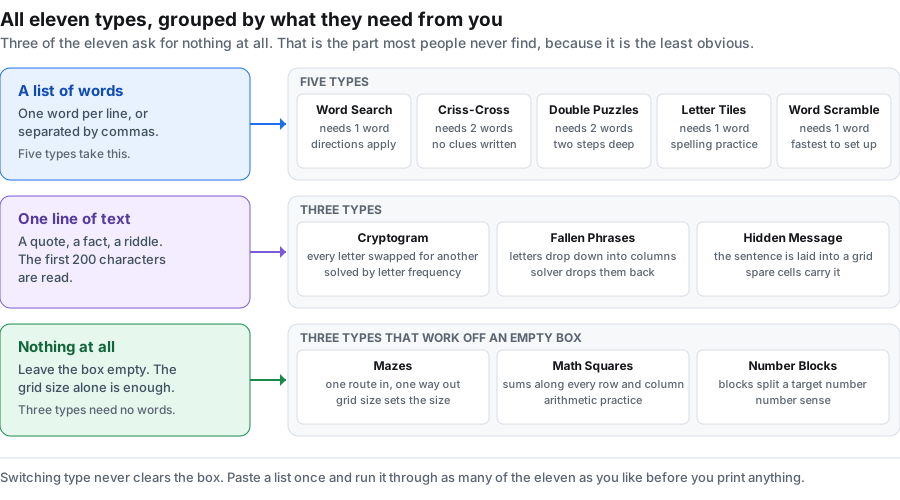
These are the eleven, and what each one is built from:
If you want the full walk-through of that grouping, the puzzle maker page sets the eleven types out by what they need from you, and the word puzzle generator page goes through what the generator does for each of the eleven.
How much ink each type puts on the sheet
This is the number nobody publishes, and it is the one that decides what a run of thirty copies costs you. Below, every type was built from the same ten-word list at grid size 14 and font size 16, and the finished sheet was counted pixel by pixel: the figure is the share of the sheet that comes out black.
| Type | What you type | Ink on puzzle page | Ink on answer page | PDF size |
|---|---|---|---|---|
| Criss-Cross | A word list | 41.39% | 41.53% | 99 KB |
| Word Search | A word list | 3.18% | 6.03% | 174 KB |
| Hidden Message | One line of text | 3.15% | 5.36% | 169 KB |
| Math Squares | Nothing | 2.30% | 2.55% | 157 KB |
| Maze | Nothing | 1.51% | 4.34% | 88 KB |
| Number Blocks | Nothing | 0.87% | 0.93% | 99 KB |
| Letter Tiles | A word list | 0.78% | 0.34% | 81 KB |
| Word Scramble | A word list | 0.37% | 0.36% | 54 KB |
| Double Puzzles | A word list | 0.36% | 0.35% | 54 KB |
| Cryptogram | One line of text | 0.34% | 0.57% | 57 KB |
| Fallen Phrases | One line of text | 0.32% | 0.63% | 61 KB |
Measured on a sheet of 190.5 by 246.7 millimetres, which is 470 cm² of paper. In those terms a criss-cross lays down 194.5 cm² of black and a fallen phrase lays down 1.5 cm². Ten of the eleven types land under 4%. One of them does not.
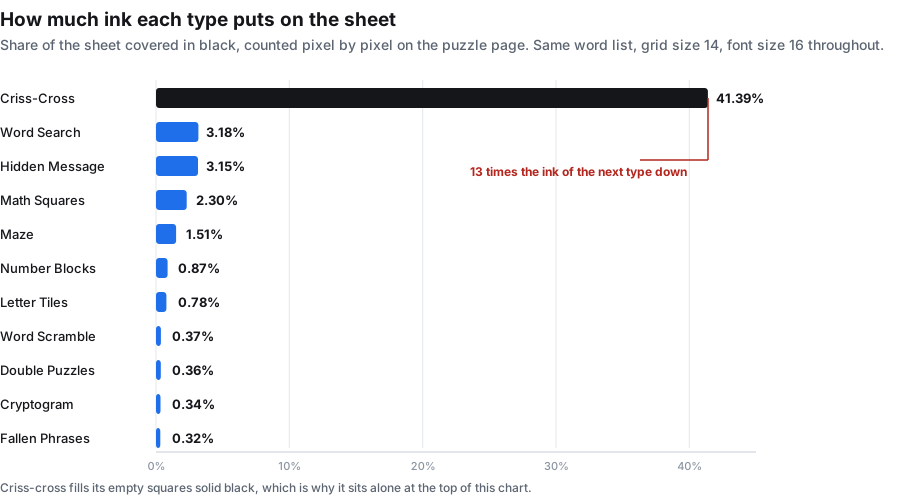
Why criss-cross sits on its own
Every empty square in a criss-cross is drawn as a solid black block, not as an outline. That is a deliberate design choice, not a rendering fault: it is what makes the crossing words read as a lattice. The cost is that a criss-cross sheet is roughly 41% black, where a word search sheet is 3%. If you are running a class set off a school printer with a toner meter on it, that difference is the whole budgeting decision. The criss-cross puzzle maker page covers what that type is and is not; the short version is that it has no clues.
Ink is not the same as file size
Here is the counter-intuitive part, and it is worth knowing before you email a sheet to somebody. A criss-cross puts thirteen times as much ink on the page as a word search, and its PDF is 43% smaller — 99 KB against 174 KB, measured on the same word list. Scattered letters are expensive to compress; a solid block is nearly free.
The practical upshot: the sheet that is cheapest to print is not the sheet that is smallest to attach. Word Search and Hidden Message are the two largest files here at 174 KB and 169 KB, and both are among the lightest on ink. If you are sending sheets to a colleague, Word Scramble, Double Puzzles and Cryptogram are the three smallest files, all under 60 KB.
The sheet itself is identical for all eleven
Every type is drawn onto the same page, so the printing settings you work out once apply to all of them. Reading the file the page actually writes, the page box is 612 by 792 points and the sheet is placed at 540.00 by 699.30 points — 190.5 by 246.7 millimetres — inside 36-point side margins. The artwork is 1600 by 2072 pixels, which works out to 213 dots per inch, and that is why the lines stay solid instead of stepping. We checked the box measurements on a word search, a maze and a criss-cross: all three came back the same, so there is no per-type page setup to learn.
- PNG gives you the sheet at its full 1600 by 2072 pixels, which is what you want for dropping into a worksheet or a slide.
- PDF gives you the US Letter page described above.
- Print sends the page you are looking at to your printer. Switch to the Answer page tab first if you want the solution on paper too.
Two print-dialog traps. Choose Actual size or 100% rather than Fit to page, which some drivers read as a few percent of shrink and the lines go soft. And leave it on portrait — the sheet is already taller than it is wide.
What the answer page adds, type by type
The answer page is not a reprint. For most types it carries extra marks, and the size of that extra varies a lot:
| Type | Puzzle page | Answer page | What was added |
|---|---|---|---|
| Word Search | 3.18% | 6.03% | The hidden words traced over — the ink nearly doubles |
| Maze | 1.51% | 4.34% | The route from start to exit, nearly triple |
| Hidden Message | 3.15% | 5.36% | The revealed line |
| Cryptogram | 0.34% | 0.57% | The solved sentence underneath |
| Fallen Phrases | 0.32% | 0.63% | The un-fallen phrase |
| Criss-Cross | 41.39% | 41.53% | Almost nothing — the letters appear inside blocks that were already black |
| Letter Tiles | 0.78% | 0.34% | Nothing added: the answer page is lighter, because the scrambled letters are replaced by the solved word |
Letter Tiles is the one type that inverts. It is also the only one where printing the answer page costs you less toner than printing the puzzle.
Three types that need nothing typed at all
If you have no list and no sentence, three of the eleven still work: Math Squares, Maze and Number Blocks. Pick one, leave the word box empty, choose a grid size, press the button. This is the fastest route to a printable puzzle on this site and the least obvious one, because the box sits there waiting for words.
The maze is the one worth knowing about. It is built from a grid size alone, and the same grid size that decides the corridor width also decides how hard the walk is. The maze generator page covers what the grid size does to the paper, and how the start and exit are fixed to two corners.
Where this page differs from what usually comes up
Search for printable puzzles and you mostly get libraries: finished puzzles on somebody else's topic, sorted by theme, with a stock image catalogue and a board of links further down the results. That is a perfectly good thing to want. You click, you print, you are done in ten seconds.
This page is the other shape. It does not contain any finished puzzles, and it never will, because the whole point is the words. This week's spelling list, the vocabulary from the unit you just finished, the names of the children in the class, a product name that is not public yet, an in-joke at a family table — no library holds any of those. Paste them here and you have a finished sheet plus its answer sheet in about thirty seconds.
Being straight about the trade, since it decides which one you should use: a library hands you somebody else's topic instantly. This page hands you your own words, and it takes half a minute. If you have no words in mind, use a library.
What you can do with the sheets
- Print as many copies as you like, for a class, a club, a waiting room or a family table.
- Hand them out on paper or attach the PDF to a message or a newsletter.
- Drop the PNG into a worksheet document, a slide or a learning platform.
- Cut the word bank off the bottom if you want solvers working from memory alone.
What this page does not do is hand you a commercial licence. The sheets are yours to print and hand out, but nothing here grants the right to sell them or to publish them as part of a product. Several of the libraries that come up for this phrase say the same thing in their terms, and it is worth saying here rather than leaving it to be discovered later.
Word lists that print well
If you arrived without a list, these four paste straight into the box:
- Autumn: PUMPKIN, HARVEST, ORCHARD, SCARECROW, CIDER, HAYRIDE, ACORN, BONFIRE, SQUASH, CROW
- Ocean animals: WHALE, DOLPHIN, OCTOPUS, CORAL, JELLYFISH, SEAL, SHARK, TURTLE, KELP, ANCHOR
- In the kitchen: KETTLE, SPOON, COLANDER, GRATER, WHISK, LADLE, SKILLET, APRON, OVEN, PANTRY
- Space: ORBIT, COMET, CRATER, GALAXY, LUNAR, SOLAR, TELESCOPE, ROCKET, METEOR, NEBULA
A spelling list works the same way: one word per line, no commas needed. Eight to fifteen entries is a comfortable sheet. If you want the same puzzle again next term, the word search generator page covers how the seed pins a layout. And if the thing you need is one printable sheet rather than eleven types, the printable word search page is dedicated to how big the squares print.
Frequently asked questions
Are these printable puzzles really free?
Yes, with nothing behind it. No account, no email, no export cap, no watermark, no trial counter, and no limit on how many copies you print.
Do I need to sign up or give an email address?
No. There is no login and no email field on this page. Open it, choose a type, press the button, print.
What kinds of printable puzzles can I make here?
Eleven: Word Search, Criss-Cross, Double Puzzles, Fallen Phrases, Math Squares, Maze, Letter Tiles, Cryptogram, Number Blocks, Hidden Message and Word Scramble. Five take a word list, three take one line of text, and three need nothing typed.
Which printable puzzle uses the least ink?
Fallen Phrases, at 0.32% of the sheet, then Cryptogram at 0.34% and Double Puzzles at 0.36%. If you want the smallest file instead of the lightest sheet, Word Scramble and Double Puzzles are the two smallest PDFs at 54 KB each.
Can I print puzzles without typing any words?
Yes. Math Squares, Maze and Number Blocks need nothing in the word box. Choose one of those three, pick a grid size and press Generate.
Does every puzzle come with an answer page?
Yes. Both pages are drawn together from one layout, so the answer can never disagree with the sheet you handed out. Switch to the Answer page tab above the canvas and use Download PNG, Download PDF or Print.
What size paper do they print on?
US Letter. The page box is 612 by 792 points and the sheet is placed at 540.00 by 699.30 points, which is 190.5 by 246.7 millimetres, inside 36-point side margins. It is the same for all eleven types.
Do they print well in black and white?
Yes — they are drawn that way, in black on white with no colour a mono printer has to approximate. Ten of the eleven types put ink on under 4% of the sheet. The exception is Criss-Cross, which fills its empty squares solid black and lands at about 41%.
Where can I print puzzles?
Anywhere there is a printer: at home, in the school workroom, or at a copy shop. Download the PDF first and take the file with you on a phone or a drive — it is one US Letter page per sheet, which is what a counter expects.
Can I use these in a classroom?
Yes, and that is the main thing they are used for. Print as many copies as you need, put your own spelling or vocabulary list in, and hand them out. Nothing here grants a commercial licence, so selling the sheets or publishing them as part of a product is not covered.
How many copies can I print?
As many as you like. The puzzle is drawn in your browser and the file is yours; nothing on this page counts prints or caps them.
Do my words get uploaded anywhere?
No. The generator runs as script in this tab: no request is sent, nothing is written to storage, and there is no account for a list to be attached to. Close the tab and the words are gone.
Can I make them without an internet connection?
Once the page has loaded, yes. Nothing in generating or printing calls a server, so you can drop off the network and keep making puzzles.
Can I make printable puzzles in Microsoft Word?
Not with this page — it is not a Word template and it does not hand out a document file. What it does instead is skip the fiddly part: you paste the same list here and get a finished sheet plus its answer sheet, without drawing a table and filling it by hand. If you need the puzzle inside an existing Word document, download the PNG and drop it in as a picture.
Why is one of my words missing?
There was no room for it at the current grid size. A red line under the puzzle title names it and the word bank leaves it out, so a printed sheet never promises a word a solver cannot find. Raise the grid size or shorten the word.
How do I get the same puzzle again next term?
Type a word into the Seed box before you generate. The same seed with the same word list rebuilds the identical layout later, so you can reprint a sheet you handed out months ago.
Where do I find the other ten types?
Right here, in the Puzzle type box at the top of this page — your word list stays in the box when you switch. The home page generator does the same thing, and each type also has its own page with the details that matter to it.
Can I make printable word puzzles for adults?
Yes — nothing here is graded by age. Adults usually want a longer list and a tighter grid, so pick a grid of 14 to 20 and put in 20 to 40 words. If you want it genuinely hard, turn on the diagonal and reversed directions; on a word search that is what makes a sheet slow to solve. The word list is yours, so it can be technical vocabulary, names, or in-jokes.
Can I make printable word puzzles for kids?
Yes, and the two settings that matter are grid size and list length. A grid of 10 prints squares about 16.9 millimetres across, which leaves room for a young child to circle a letter; a grid of 20 shrinks them to about 8.5 millimetres. Keep the list to eight to twelve short words. Full measurements are on the printable word search page.
Can I make printable word puzzles for seniors?
Yes, with one limit you should know before you promise anything. The font size slider runs from 10 to 26, and 26 prints letters about 2.26 millimetres high — that is 8.8 point, well under the 16 to 18 point of a true large print book. Grid size does not make letters bigger, only the squares. If the reader needs real large print, read the measured tables on the large print word search page first; the practical route there is to print the sheet at 150% or more.
Do I get a PDF, or do I have to print from the browser?
Both, and the PDF is the one to use if you are printing somewhere else. Download PDF gives you a single US Letter page, 612 by 792 points, with the puzzle on it — or the answer page, depending on which tab is open. It is a real file on your device, so you can email it, put it on a drive, or hand it to a copy counter.